Google Search

Wednesday, May 23, 2012

New Nvidia Drivers Available Geforce 301.42 Driver

This is the first WHQL-certified unified driver from the R300 family of drivers (versions 300.00 to 301.99).

GeForce R300 drivers are packed with new industry-leading, GeForce-exclusive features as well as some really nice performance increases in top games.

New in R300 Drivers:

  • New GPU Support:
    • GeForce GTX 690
    • GeForce GTX 680
    • GeForce GTX 670
    • GeForce GT 600-series GPUs

  • Performance Boost – Increases performance for GeForce 400 Series and 500 Series GPUs in several PC games vs. GeForce 296.10 WHQL-certified drivers. Results will vary depending on your GPU and system configuration: GeForce GTX 570/580:
    • Up to 23% in Just Cause 2 with SLI
    • Up to 21% in The Elder Scrolls V: Skyrim
    • Up to 17% in StarCraft II with SLI
    • Up to 14% in Far Cry 2 with SLI
    • Up to 9% in Bulletstorm
    • Up to 7% in Civilization V
    • Up to 6% in Deus Ex: Human Revolution with SLI
    • Up to 6% in Dragon Age 2 with SLI
    • Up to 5% in Metro 2033 with SLI
    • Up to 5% in Total War: Shogun 2
    GeForce GTX 560/560 Ti:
    • Up to 20% in The Elder Scrolls V: Skyrim
    • Up to 15% in Just Cause 2 with SLI
    • Up to 13% in Far Cry 2 with SLI
    • Up to 12% in Bulletstorm
    • Up to 11% in Civilization V
    • Up to 10% in StarCraft II with SLI
    • Up to 9% in Batman: Arkham City
    • Up to 4% in Deus Ex: Human Revolution with SLI
    • Up to 4% in Dragon Age 2 with SLI
    • Up to 4% in Metro 2033 with SLI
    • Up to 4% in Total War: Shogun 2

EVGA Give Away Mafia II Free

Get Mafia II Free!

Get Mafia II free with a purchase of a qualifying* GTX 460 or GTX 560!

With the purchase of a qualifying GTX 460 or GTX 560 from participating e-tailers, you will get a free copy of Mafia II with purchases on or after 1/4/11 while supplies last! Once you request a code for your purchase, please make sure you have an invoice uploaded so your Steam Code will be approved and sent to you.

Participating e-tailers

  • Amazon
  • Newegg
  • Tiger Direct
  • Tiger Direct

  • Watch the environment explode in up to 10,000 lifelike particles as you blast cement, wood, glass, dirt, and more

  • Using PhysX, clothing in Mafia II has the weight and texture of real life clothing and as your character moves and reacts with the physical world, so does their clothing

  • Mafia II is optimized for NVIDIA 3D Vision and 3D Vision Surround to create a truly immerse Mafia world in full stereoscopic 3D

Qualifying Part Numbers

  • 02G-P3-1469-KR
  • 02G-P3-1387-AR
  • 02G-P3-1387-KR
  • 01G-P3-1468-KR
  • 01G-P3-1466-KR
  • 01G-P3-1464-KR
  • 01G-P3-1463-KR
  • 01G-P3-1461-KR
  • 01G-P3-1460-KR
  • 01G-P3-1380-KR
  • 01G-P3-1378-TR
  • 01G-P3-1370-KR
  • 01G-P3-1363-KR
  • 01G-P3-1361-KR

Tuesday, May 22, 2012

NVIDIA losing ground to AMD and Intel in GPU market

NVIDIA may be kicking all kinds of Butt on the mobile front with its ubiquitous Tegra 2 chipset, but back on its home turf of laptop and desktop graphics, things aren't looking so hot. The latest figures from Jon Peddie Research show that the GPU giant has lost 2.5 percentage points of its market share and now accounts for exactly a fifth of graphics chips sold on x86 devices. That's a hefty drop from last year's 28.4 percent slice, and looks to have been driven primarily by sales of cheaper integrated GPUs, such as those found inside Intel's Clarkdale, Arrandale, and most recently, Sandy Bridge processors. AMD's introduction of Fusion APUs that combine general and graphics processing into one has also boosted its fortunes, resulting in 13.3 percent growth in sales relative to the previous quarter and a 15.4 percent increase year-on-year. Of course, the real profits are to be made in the discrete graphics card market, where NVIDIA remains highly competitive, but looking at figures like these shows quite clearly why NVIDIA is working on an Arm CPU for the desktop.bt vlad savoy       

Monday, May 21, 2012

Creative New Soundblaster series Cards

Creative have taken a hiatus when it comes to sound cards and never really launched anything new after their X-Fi series. Since then Asus has taken over as the go-to company for sound cards and currently dominate this space. Creative’s now back with a whole new line-up of sound cards that they recently launched in India. The new series is based upon their new SoundCore3D processor that supports hardware acceleration of THX TruStudio Pro. It also features CrystalVoice processing that lets you communicate with crystal clear vocal fidelity in your multiplayer games, online chats and video conferencing. The new series is engineered for low power consumption and high performance and the Sound Core3D processor is Creative's first sound and voice processor to integrate a quad-core high-performance digital signal processor (DSP) and high-quality converters onto a single chip.
The new series
The new series

The series consists of three internal PCIE sound cards for the PC. The Sound Blaster Recon3D Fatal1ty Champion is the flagship of the lot and is targeted at pro-gamers. The sound card is shielded in a specially designed casing and comes together with the I/O Drive to give you convenient access to headphone and microphone inputs, as well as volume and THX TruStudio Pro controls. It also supports studio quality headphones and headsets of up to 600 ohm impedance. Scout Mode allows you to hear your enemies from further away, giving you a distinct tactical advantage in combat. This is priced at Rs.14,500. The Recon3D Fatal1ty Professional is a slightly less hard-core version, which comes without the front-panel input, so it’s a little cheaper at Rs.11,999. The Recon3D PCIE is a plain Jane version of the above two, which is priced at Rs.7,999. They also launched an external universal sound card that’s compatible with an Xbox 360, PS3, PC or Mac. It supports hardware-accelerated THX TruStudio Pro and Dolby Digital decoding it transforms even basic stereo sound into 3D surround audio on your headset or speakers. This one’s priced at Rs.9,900.

NVIDIA Launches Femi Based GeForce Professional Products

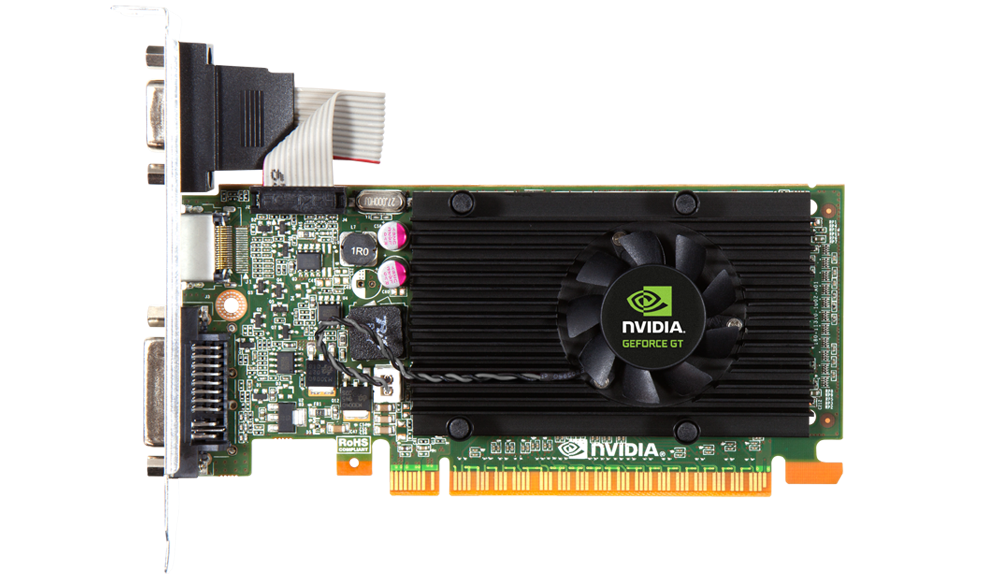
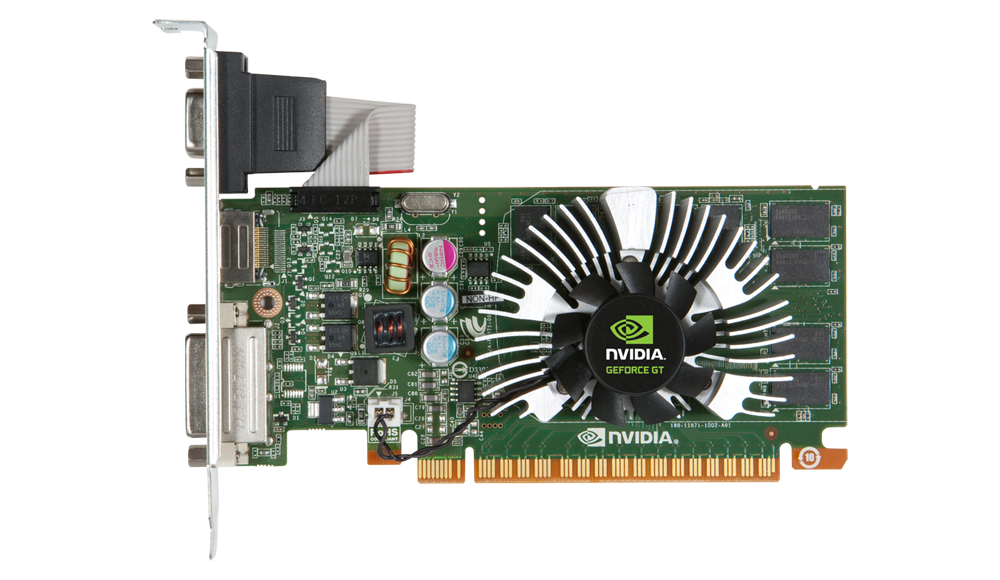
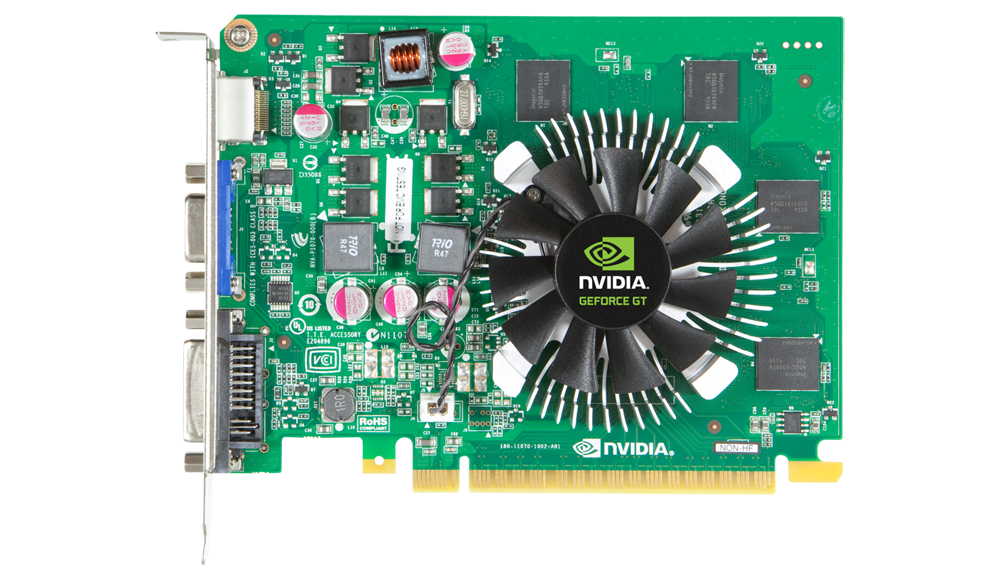
 NVIDIA’s latest professional products, NVIDIA’s GeForce group was busy with some launches of their own. The company has quietly launched the GeForce GT 610, GT 620, and GT 630 into the retail market. Unfortunately these are not the Kepler GeForce cards that you were probably looking for.
GT 630 GDDR5GT 630 DDR3GT 620GT 610
Previous Model Number GT 440 GDDR5 GT 440 DDR3 N/A GT 520
Stream Processors 96 96 96 48
Texture Units 16 16 16 8
ROPs 4 4 4 4
Core Clock 810MHz 810MHz 700MHz 810MHz
Shader Clock 1620MHz 1620MHz 1400MHz 1620MHz
Memory Clock 3.2GHz GDDR5 1.8GHz DDR3 1.8GHz DDR3 1.8GHz DDR3
Memory Bus Width 128-bit 128-bit 64-bit 64-bit
Frame Buffer 1GB 1GB 1GB 1GB
GPU GF108 GF108 GF108/GF117? GF119
TDP 65W 65W 49W 29W
Manufacturing Process TSMC 40nm TSMC 40nm TSMC 40nm TSMC 40nm
As NVIDIA was already reusing Fermi GPUs for GeForce 600 series parts for the OEM laptop and desktop market, it was only a matter of time until this came over to the retail market, and that’s exactly what has happened. The GT 610, GT 620, and GT 630 are all based on Fermi GPUs, and in fact 2 of them are straight-up rebadges of existing GeForce 400 and 500 series cards. Worse, they’re not even consistent with their OEM counterparts – the OEM GT 620 and GT 630 are based off of different chips and specs entirely.
At the bottom of the 600 series retail stack is the GeForce GT 610, which is a rebadge of the GT 520. This means it’s either a GF119 GPU or cut-down GF108 GPU featuring a meager 48 CUDA Cores and a 64bit memory bus, albeit with a low 29W TDP as a result. This is truly a rock bottom card meant to be a cheap as possible upgrade for older computers, as even an Ivy Bridge HD4000 iGPU should be able to handily surpass it.
The second card is the GT 620, which is a variant of the OEM-only GT 530. With 96 CUDA cores we’re not 100% sure that this is GF108 as opposed to the 28nm GK117, but as NVIDIA currently has a 28nm capacity bottleneck we can’t see them placing valuable 28nm chips in low-end retail cards. Furthermore the 49W TDP perfectly matches the GF108 based GT 530. Compared to the OEM GT 620 the retail model has twice as many CUDA cores, so it has twice as much shader performance on paper, but because of the 64bit memory bus it’s going to be significantly memory bandwidth starved.
The final new 600 series card is the GT 630, which is a rebadge of the GT 440. Like the GT 440 this card comes in two variants, a model with DDR3 and a model with GDDR5. Both models are based on GF108 and have all 96 CUDA cores enabled, and have the same core clock of 810MHz. At the same time this is going to be the card that deviates from its OEM counterpart the most. The OEM GT 630 was a Kepler GK107 card, so this rules out getting a Kepler based GT 630 retail card any time in the near future.
As always, rebadging doesn’t suddenly make a good card bad  but it’s disappointing to once again see this mess transition over to the retail market. We hold to our belief that previous generation products are perfectly acceptable as they were, and that the desire to have yearly product numbers in an industry that is approaching 2 year product cycles is silly at its best, and confusing at its worst.by ryan smith

EVGA Recalls GeForce GTX 670 SuperClocked Cards

Kyle Bennett over at [H]ard|OCP has learned that EVGA is recalling their GeForce GTX 670 SuperClocked (SC) video cards due to some bad products that managed to get out the door. It appears that some of the cards are artifacting in games and benchmarks. EVGA has only been selling the card for a week, so this is a very small recall and EVGA is going to be taking care of customers by replacing their card with an EVGA GeForce GTX 670 FTW version at no additional cost! We reviewed the EVGA GTX 670 Superclock card (P/N: 02G-P3-2672-KR) last week and had no problems with our card, but if you have one you might as well switch it out for an upgrade!
EVGA GeForce GTX 670 SuperClocked

EVGA has isolated this problem to an early batch of GTX 670 Superclock cards (P/N: 02G-P3-2672-KR) that were not properly screened during QA/QC procedure. We have already been working with our partners to retest this particular batch. In the meantime, our R&D has also done numerous tests, burn in and component quality verification to confirm that the EVGA GTX 670 Superclock is a well designed product. If any of your users are experiencing issues with their EVGA GTX 670 Superclock boards, please ask them to email Jacob Freeman (jacobf[at]evga[dot]com), and he will assist in getting them setup with an RMA cross shipment along with EVGA upgrading them to the GTX 670 FTW version (P/N: 02G-P3-2685-KR) for the inconvenience of this.

AMD Radeon 7990 Specs

The AMD Radeon HD 7990 codenamed “New Zealand” has surfaced, with TechPowerUp having posted an image of the reference design along with a GPU-Z screen cap of the graphics card’s specifications.
The ventilation design of the GTX 590 seems to be copied to a very large extent, while maintaining the reference fan design that was on the 7850 and the 7770.
The card seems to be as long as 10 inches in terms of length while also boasting a PCB number
The card, in terms of specifications will come with a 1 GHz core clock speed with the memory clocked to 1250 MHz.
The card will come with 6GB of DDR5 memory that is allocated as 3GB per GPU.
The GPUs will both have 2048 stream processors each and the card being powered up by two 8 pin connectors.
In terms of display, there will be one dual-link DVI port, with the additional four mini DisplayPort connectors.
The card is slated for a proper hard launch by AMD on the 17th of April and the price has been set at US $849.
AMD Radeon HD 7990 GHz Edition